
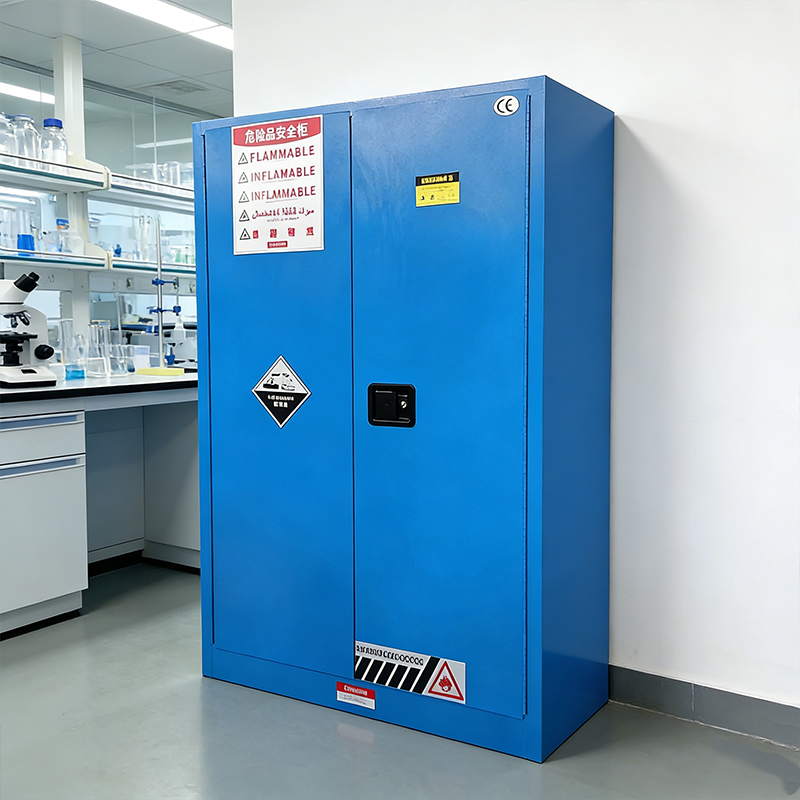
Proper storage of flammable liquids is a critical component of laboratory safety management. While standard cabinet sizes may suit small applications, many laboratories require custom flammable storage cabinets to match their chemical volume, space constraints, and regulatory requirements.
Selecting the right size and capacity is not just about storage convenience — it directly impacts fire safety, compliance, and operational efficiency. Here’s how to make the right decision for your lab.
1. Assess the Volume of Flammable Liquids
The first step is calculating the total quantity of flammable liquids stored in your laboratory.
Consider:
-
Current solvent and chemical inventory
-
Maximum allowable storage limits under local regulations
-
Frequency of chemical replenishment
-
Future expansion plans
Avoid selecting a cabinet that is already near full capacity. Overcrowded storage increases spill risks and reduces accessibility during emergencies.
2. Understand Regulatory Storage Limits
Different regions impose limits on the amount of flammable liquids that can be stored outside of dedicated chemical storage rooms.
Common standards include:
-
EN 14470-1 (European fire-resistant cabinets)
-
NFPA 30 (Flammable and combustible liquids code)
-
OSHA regulations in the United States
Ensure your custom cabinet design aligns with fire rating requirements (e.g., Type 30, Type 60, or Type 90) and maximum permitted storage quantities.
3. Evaluate Available Laboratory Space
Laboratory layouts vary significantly. Before choosing cabinet dimensions:
-
Measure available floor space
-
Consider door swing clearance
-
Account for proximity to exits and workstations
-
Ensure compliance with emergency access requirements
Custom flammable storage cabinets can be designed as under-bench units, tall vertical cabinets, or integrated modular systems to optimize limited laboratory space.
4. Determine Shelf Configuration and Load Capacity
Capacity is not only about total volume but also internal configuration.
When customizing your cabinet, consider:
-
Adjustable shelves for different container heights
-
Load-bearing capacity per shelf
-
Spill containment sump depth
-
Segregation options for incompatible chemicals
Proper internal organization improves both safety and daily workflow efficiency.
5. Consider Ventilation and Environmental Conditions
Depending on regulatory requirements, your cabinet may need ventilation ports for connection to a laboratory exhaust system.
You should confirm:
-
Whether external ventilation is mandatory
-
Required airflow rate
-
Compatibility with existing ventilation infrastructure
-
Environmental conditions such as humidity and corrosive exposure
Custom designs can incorporate ventilation interfaces while maintaining fire resistance integrity.
6. Plan for Future Laboratory Growth
Laboratories evolve. Selecting a cabinet based only on current needs may lead to costly replacements later.
A scalable approach may include:
-
Selecting a slightly larger capacity than currently required
-
Designing modular systems that allow additional units
-
Planning centralized flammable storage zones
Forward planning enhances long-term compliance and operational flexibility.
Conclusion
Choosing the right size and capacity for custom flammable storage cabinets requires careful evaluation of chemical volume, regulatory limits, available space, internal configuration, and future expansion plans.
A properly sized and compliant cabinet not only improves fire safety but also enhances laboratory efficiency and regulatory readiness. By working with an experienced manufacturer, laboratories can obtain tailored storage solutions that balance safety, compliance, and practical functionality.
Investing in the correct custom flammable storage cabinet is an essential step toward a safer and more organized laboratory environment.


 Address: No. 11, 11th Floor, Unit 2, Bldg 2, No.1, Section 1, Huayang Huafu Avenue, Tianfu New Area, Chengdu, ChinaMobile phone: +86-135 5039 0813Telephone: 00 86 28 8914 2335 Email: lily@cdample.com
AMPLE Solutions is a manufacturer and integrated solution provider of laboratory safety and workplace equipment, specializing in fume hoods, safety storage cabinets, laminar flow cabinets, acoustic pods, and ergonomic solutions. We deliver customized, internationally compliant solutions for universities, pharmaceutical facilities, research institutes, hospitals, and government projects worldwide, meeting CE, EN, ISO, NFPA, and ASHRAE standards.
Copyright © 2026 成都安普乐进出口贸易有限公司 Ltd. All Rights Reserved. POWERED BY WEIMOBTRADE
