
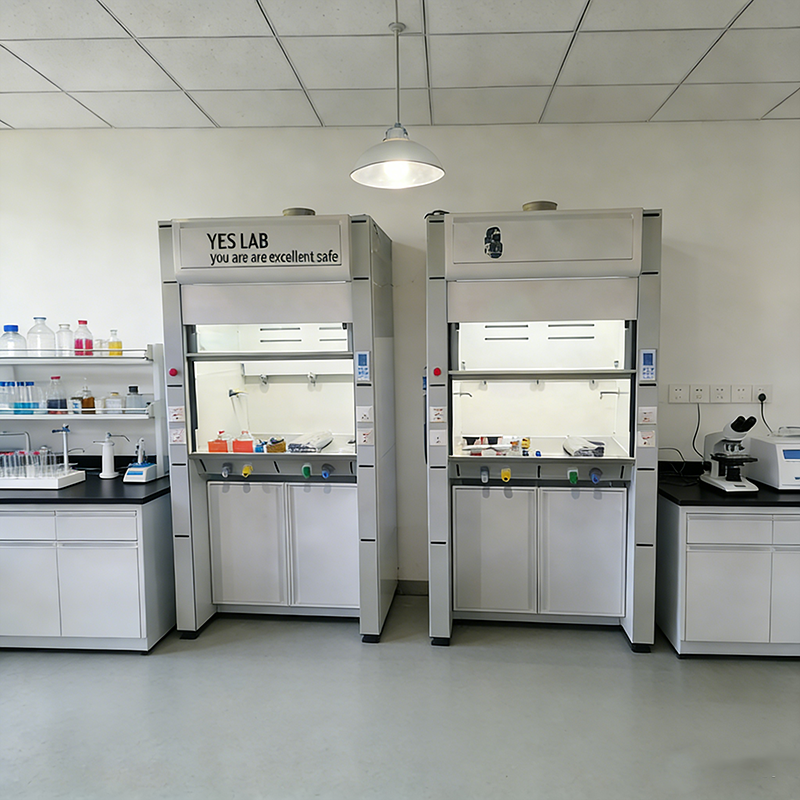
Selecting the right laboratory fume hood is a critical decision in any laboratory construction or renovation project. A properly chosen fume hood ensures operator safety, regulatory compliance, and long-term performance — while an incorrect selection can lead to airflow problems, safety risks, and costly redesigns.
Here’s a practical guide to help you choose the right fume hood for your laboratory project.
1. Identify the Type of Chemicals Being Used
The first step is understanding your laboratory application.
Ask yourself:
-
Are you handling volatile organic solvents?
-
Are corrosive acids or alkalis involved?
-
Is there a risk of toxic or hazardous fumes?
-
Are radioactive or specialized materials being used?
For corrosive environments, PP (polypropylene) fume hoods are often preferred. For general chemistry labs, powder-coated steel fume hoods are commonly used.
Matching the fume hood material to the chemical environment is essential for durability and safety.
2. Choose Between Ducted and Ductless Fume Hoods
One of the most important decisions is whether to install a ducted or ductless system.
Ducted Fume Hoods
-
Connected to external exhaust systems
-
Suitable for high-risk or high-volume chemical use
-
Provide strong and continuous containment
Ductless Fume Hoods
-
Use advanced filtration systems
-
Easier installation
-
Ideal for light chemical applications
For most large laboratory projects, ducted fume hoods are recommended due to their superior exhaust capability.
3. Evaluate Airflow Performance and Face Velocity
Proper airflow control is essential for containment.
Key parameters include:
-
Face velocity (typically 0.3–0.5 m/s depending on standards)
-
Airflow stability
-
Internal baffle design
-
Energy efficiency performance
Low-quality airflow design can cause turbulence, increasing exposure risk. Always verify airflow testing data from the manufacturer.
4. Ensure Compliance with Safety Standards
Laboratory fume hoods should comply with relevant international standards, such as:
-
EN standards (Europe)
-
OSHA regulations (United States)
-
ASHRAE ventilation guidelines
For global projects, CE compliance and documented performance testing are often required.
Certification ensures the fume hood meets safety and structural requirements for laboratory use.
5. Consider Laboratory Layout and Space Constraints
Laboratory design impacts fume hood selection.
Important factors include:
-
Available floor space
-
Ceiling height
-
Duct routing possibilities
-
Proximity to doors, windows, and walkways
Common sizes include 1200mm, 1500mm, and 1800mm wide units, but custom dimensions may be required for specialized layouts.
6. Plan for Energy Efficiency and Long-Term Operation
Fume hoods are among the highest energy-consuming devices in a laboratory due to continuous airflow.
Modern projects increasingly prioritize:
-
Variable air volume (VAV) systems
-
Low-flow designs
-
Energy-saving sash systems
Selecting an energy-efficient fume hood reduces operational costs and supports sustainable laboratory design.
7. Work with an Experienced Manufacturer
Finally, choosing the right supplier is just as important as selecting the right model.
Look for a manufacturer that provides:
-
Compliance documentation
-
Customization capabilities
-
Technical support
-
Project references
-
Stable manufacturing quality
An experienced laboratory fume hood manufacturer can help optimize specifications and prevent costly mistakes during project execution.
Conclusion
Choosing the right fume hood for your laboratory project requires careful evaluation of chemical type, ventilation method, airflow performance, regulatory compliance, layout constraints, and long-term operational needs.
A well-selected fume hood enhances chemical safety, improves laboratory efficiency, and ensures regulatory approval. By working with a reliable manufacturer and clearly defining project requirements, you can ensure your laboratory is both safe and future-ready.


 Address: No. 11, 11th Floor, Unit 2, Bldg 2, No.1, Section 1, Huayang Huafu Avenue, Tianfu New Area, Chengdu, ChinaMobile phone: +86-135 5039 0813Telephone: 00 86 28 8914 2335 Email: lily@cdample.com
AMPLE Solutions is a manufacturer and integrated solution provider of laboratory safety and workplace equipment, specializing in fume hoods, safety storage cabinets, laminar flow cabinets, acoustic pods, and ergonomic solutions. We deliver customized, internationally compliant solutions for universities, pharmaceutical facilities, research institutes, hospitals, and government projects worldwide, meeting CE, EN, ISO, NFPA, and ASHRAE standards.
Copyright © 2026 成都安普乐进出口贸易有限公司 Ltd. All Rights Reserved. POWERED BY WEIMOBTRADE
