
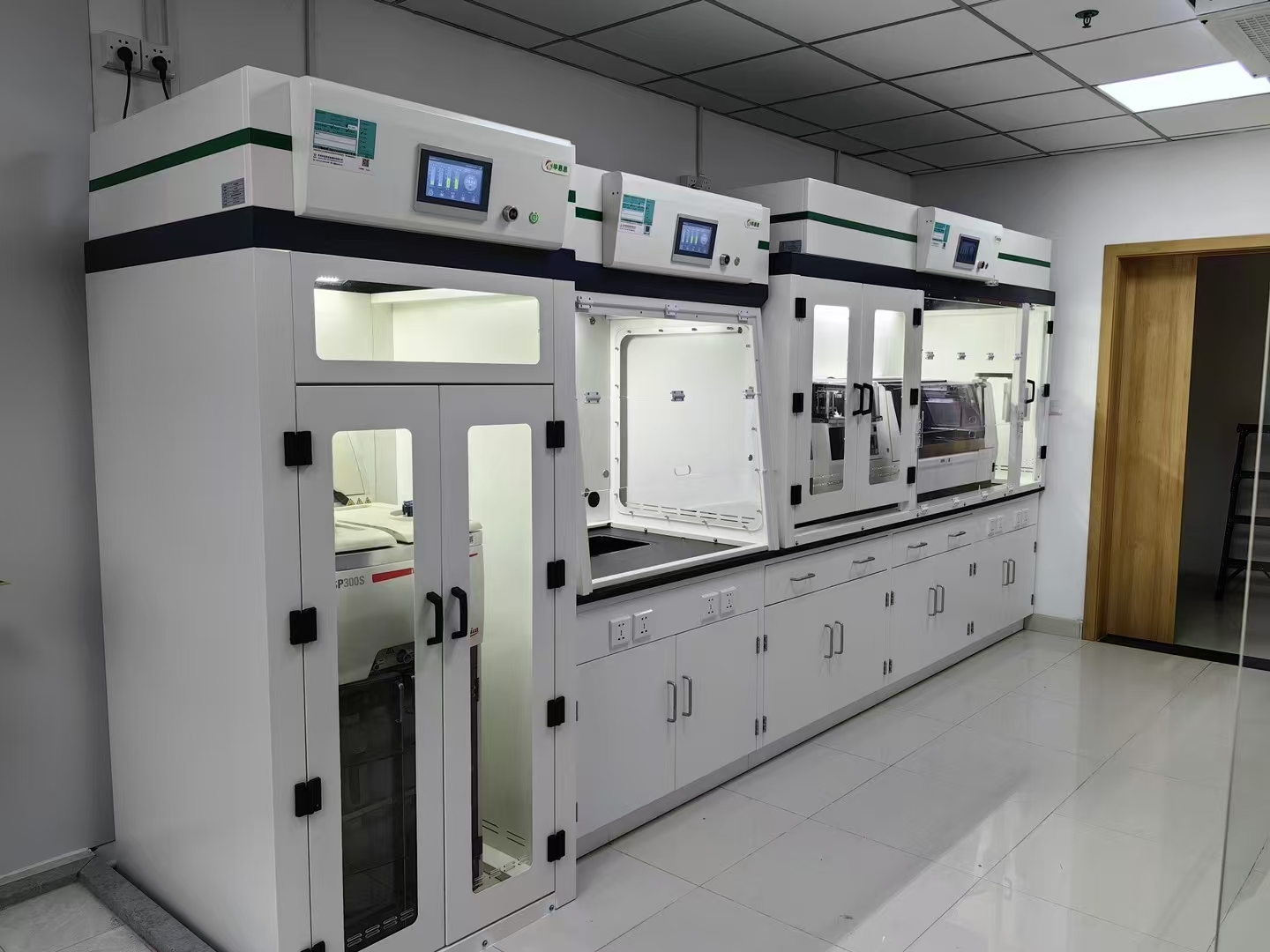
In chemical laboratories, controlling airborne contaminants is critical to ensuring personnel safety and regulatory compliance. A laboratory fume hood plays a central role in managing airflow, containing hazardous fumes, and protecting operators from exposure to toxic or flammable substances.
Understanding how a fume hood improves airflow control helps laboratory planners and project managers make informed decisions when designing safe and efficient lab environments.
The Principle of Airflow Control in a Fume Hood
A fume hood works by creating a controlled airflow pattern that draws air from the laboratory into the enclosure and safely exhausts contaminated air away from the user.
The system is designed to:
-
Maintain consistent face velocity
-
Prevent backflow of hazardous vapors
-
Minimize turbulence inside the work chamber
-
Direct contaminated air through internal baffles
-
Exhaust air safely outside the building or through filtration systems
This controlled airflow creates a protective barrier between the operator and hazardous chemicals.
Maintaining Proper Face Velocity
Face velocity refers to the speed at which air enters the front opening of the fume hood. Typical recommended face velocity ranges from 0.3 to 0.5 m/s, depending on regulatory standards and laboratory application.
Proper face velocity:
-
Prevents fumes from escaping into the lab
-
Reduces operator inhalation risk
-
Enhances containment efficiency
-
Maintains stable airflow during sash movement
Advanced airflow monitoring systems can continuously measure and adjust velocity to maintain safe operating conditions.
Internal Baffle Design and Airflow Distribution
The internal baffle system inside a fume hood plays a crucial role in airflow stability.
Well-designed baffles:
-
Distribute airflow evenly from top to bottom
-
Prevent dead zones where fumes may accumulate
-
Reduce turbulence that can push contaminants outward
-
Improve overall containment performance
Poor airflow design may lead to eddies and leakage, increasing exposure risks.
The Role of the Sash in Operator Protection
The movable glass sash is both a physical and aerodynamic safety component.
It:
-
Acts as a physical barrier against splashes or small explosions
-
Controls airflow opening size
-
Helps maintain optimal face velocity
-
Protects the operator’s upper body and face
Lower sash positions improve containment efficiency while enhancing personal protection.
Exhaust Systems and Contaminant Removal
In ducted fume hoods, contaminated air is safely discharged outside the building through a dedicated exhaust system. In ductless models, high-efficiency filtration systems capture chemical vapors before air is recirculated.
Proper exhaust design ensures:
-
Continuous removal of hazardous vapors
-
Reduced indoor air contamination
-
Compliance with ventilation standards
-
Improved overall laboratory air quality
Energy Efficiency and Airflow Optimization
Modern fume hoods incorporate energy-saving features such as:
-
Variable Air Volume (VAV) systems
-
Low-flow airflow designs
-
Automatic sash position monitoring
These technologies maintain operator protection while reducing energy consumption, which is critical for large laboratory facilities.
Why Airflow Control Directly Impacts Operator Safety
Effective airflow control reduces risks such as:
-
Toxic inhalation exposure
-
Fire hazards from flammable vapor buildup
-
Cross-contamination between experiments
-
Long-term health effects from chemical exposure
By maintaining stable containment and controlled ventilation, a properly designed fume hood significantly enhances laboratory safety.
Conclusion
A laboratory fume hood improves airflow control by maintaining consistent face velocity, optimizing internal airflow distribution, and safely exhausting hazardous contaminants. These mechanisms directly enhance operator protection and support regulatory compliance.
For any laboratory handling volatile or toxic chemicals, investing in a high-quality, well-engineered fume hood is essential for both safety and long-term operational reliability.


 Address: No. 11, 11th Floor, Unit 2, Bldg 2, No.1, Section 1, Huayang Huafu Avenue, Tianfu New Area, Chengdu, ChinaMobile phone: +86-135 5039 0813Telephone: 00 86 28 8914 2335 Email: lily@cdample.com
AMPLE Solutions is a manufacturer and integrated solution provider of laboratory safety and workplace equipment, specializing in fume hoods, safety storage cabinets, laminar flow cabinets, acoustic pods, and ergonomic solutions. We deliver customized, internationally compliant solutions for universities, pharmaceutical facilities, research institutes, hospitals, and government projects worldwide, meeting CE, EN, ISO, NFPA, and ASHRAE standards.
Copyright © 2026 成都安普乐进出口贸易有限公司 Ltd. All Rights Reserved. POWERED BY WEIMOBTRADE
